Private Churchill War Room Tours London Westminster Walk Included
Beneath the HM Treasury building on King Charles Street, the clock on the Cabinet Room wall reads 4:58pm. It has not moved since 15 October 1940. The maps are still pinned where the officers left them. The sugar lumps are still in the drawer. On 16 August 1945, the staff turned off the lights and went home. Nobody came back to change anything.
Grand Private London Tours walks you into those rooms with a dedicated guide. Your group only. Your pace. Tickets booked directly through the Imperial War Museums. No third parties. No aggregators.
The private Churchill War Rooms tour London history enthusiasts cross the Atlantic to take.
100+ Five-Star Google Reviews
What Is Included in Your Churchill War Rooms Private Tour
Every booking with Grand Private London Tours includes the full experience, not just entry.
Your guide meets your group at your hotel and travels with you to Westminster. The tour opens with a private walking tour of the streets above the bunker: Whitehall, King Charles Street, Treasury Gardens, 10 Downing Street, the Cenotaph, Parliament Square, and Churchill’s statue. The walk takes approximately 60 to 75 minutes. It sets up everything you are about to see underground.
After the walk, your guide leads you through the Churchill War Rooms themselves: the Cabinet Room, the Map Room, the Transatlantic Telephone Room, and Churchill’s bedroom. The full experience runs approximately four hours.
Included in your booking: official IWM entry tickets booked directly from the Imperial War Museums website, hotel pickup, a fully licensed private guide (PHO Licence 00324), and a tour timed to arrive before the peak mid-morning crowd. Churchill War Rooms receives 557,009 visitors per year, roughly 1,526 every day. The corridors are the same width they were in 1940. Arriving at the right time makes all the difference.
Group sizes from 2 to 30 were welcomed. Mercedes V-Class, S-Class, E-Class, Vito, and luxury minibus are available for larger groups.
Your Tour Starts Above Ground The Westminster Walk
This is the part most Churchill War Rooms tours skip entirely. They drop visitors at the entrance on King Charles Street and send them underground with an audio guide. We walk Whitehall first. The reason is simple: you cannot understand what is underground without standing on the streets above it.
Westminster tube station (Circle, District, and Jubilee lines) is your starting point. From Exit 2 on Bridge Street, you are a five-minute walk from the entrance to the War Rooms. That five-minute walk passes the Houses of Parliament, crosses Parliament Square, moves down Whitehall, the street that has connected Parliament to Trafalgar Square for centuries, and arrives at King Charles Street SW1A 2AQ. Your guide turns those five minutes into the context for everything you are about to see.
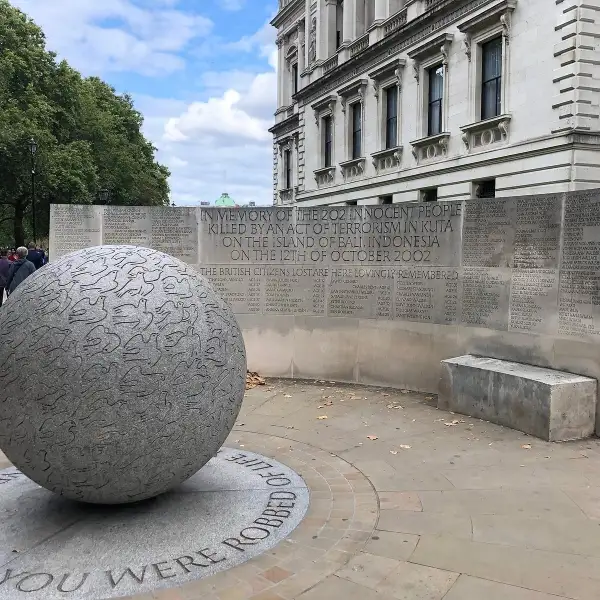
Clive Steps and the Bali Memorial Where a German Bomb Fell
Clive Steps leads down from King Charles Street to St. James’s Park. Named after Clive of India, the 18th-century East India Company clerk who became the first British governor of Bengal. At the bottom of these steps, in September 1940, a German bomb fell. Today that spot holds the Bali Memorial, placed here in 2002. Stand on it, and you are standing exactly where the closest live German bomb landed to the Cabinet War Rooms. Your guide stops here before you go inside.

Treasury Gardens and 10 Downing Street: The Bomb That Changed Everything
The narrow gap beside Number 10, the one you see on the news every night, is Treasury Gardens. A German bomb fell there in autumn 1940. It blew out every window at the back of Downing Street and killed two Home Guard members in the Treasury basement. Churchill was hosting a dinner party. His cook refused to leave; the sauce would ruin. He insisted. Everyone went downstairs. The bomb dropped. Nobody died.
The next morning he moved his war cabinet underground. That is why the clock reads 4:58pm.
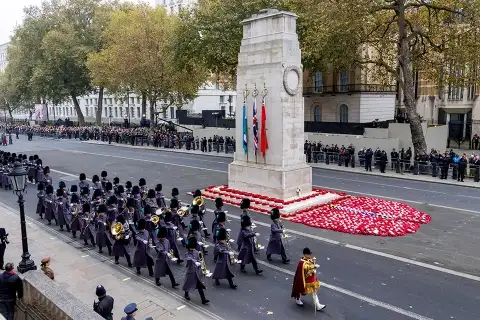
The Cenotaph, Whitehall SW1A 2JR
Every Westminster tour passes it. Most guides say nothing useful. Sir Edwin Lutyens designed the Cenotaph as a temporary wooden structure for the peace parade of July 1919. One million people came to lay wreaths. Nobody could bear to take it down. It was rebuilt in Portland stone and unveiled on Armistice Day 1920, now the national monument to every British serviceman and woman who died in both world wars. Your guide stands beside it and tells you what it meant to walk past it in 1940, when the war was still being lost.
Churchill’s Statue, Parliament Square SW1P 3JX
The bronze statue faces the Palace of Westminster—the building he fought to protect. Sculptor Ivor Roberts-Jones completed it in 1973. Churchill leans forward in a heavy overcoat, walking stick in hand. Your guide explains what that posture was designed to say. Two minutes further along your route stands the Women of World War II Monument on Whitehall 17, with uniforms cast in bronze, representing 640,000 British women who served. Most people who pass it daily have no idea what it represents. Your guide stops there too.
Descending Into the Bunker What Happened in These Rooms
Ten feet underground. Not a reinforced bunker. Just the basement of the New Public Offices, a government building at the corner of Horse Guards Road and King Charles Street, was chosen in 1938 because it had a steel frame and was the strongest building in Whitehall. Too late to build anything new. Too short of money. So they made the best of a basement.
IWM Curator Nigel Steel said it plainly: “This is a very British place. We couldn’t afford to build anything special, so we came here and made it as safe as we could.”
Churchill asked his staff directly: “Are we safe?” Their answer: “Not really, Prime Minister.” He ordered 1.5 meters of concrete to be poured into the floor above. It is still there today. It was never going to stop a direct hit. The people who worked here knew that. They stayed anyway.
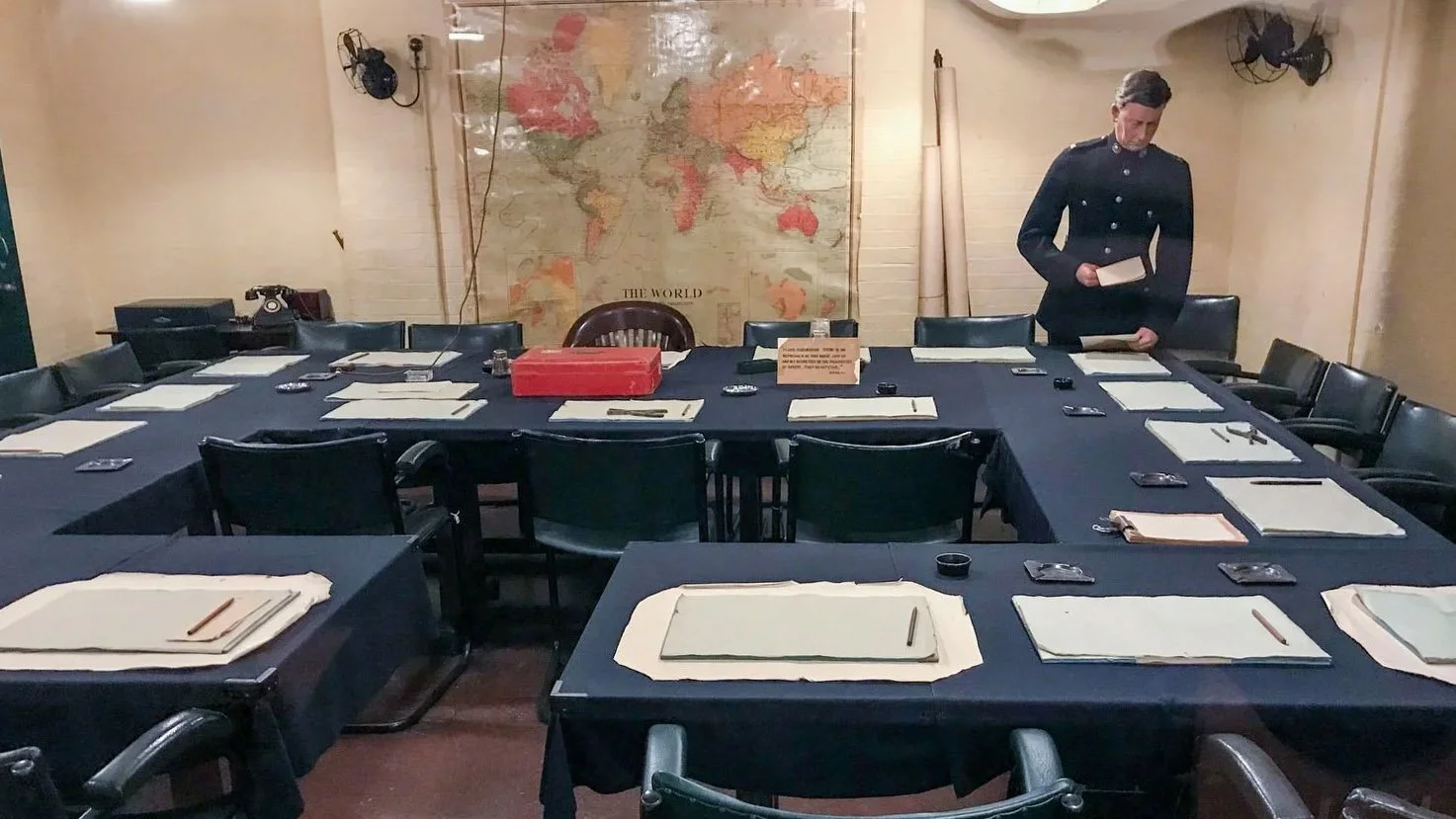
The Cabinet Room 116 Meetings That Changed the Course of History
The clock reads 4:58pm. Set permanently to that moment, the first Cabinet meeting was held here, 15 October 1940. Churchill’s chair sits at the head of the table. It is the only different chair in the room.
Look at the right arm. A groove was worn into the wood of his signet ring, banged on the armrest in frustration during meetings. On the left arm, the marks of his fingernails are drawn backwards and forwards in tension. IWM Curator Nigel Steel calls it the physical manifestation of his leadership, still present in the wood 80 years later.
Clement Attlee sat to his left. Sir Edward Bridges to his right. Opposite Churchill: three chairs for the Chiefs of Staff of the Royal Navy, the Army, and the Royal Air Force. He could not order them directly. He had to persuade. They had to stop him doing anything that could lose the war. The air came from Horseferry Road, almost a kilometer away, and came out black if you held a white handkerchief to the vent. Churchill alone went through eight Romeo y Julieta Havanas per day.
116 meetings in this room. One visitor who had been to Normandy, Eagle’s Nest, and Dachau said, “Almost nowhere have I felt closer to that part of history.” This room is why.
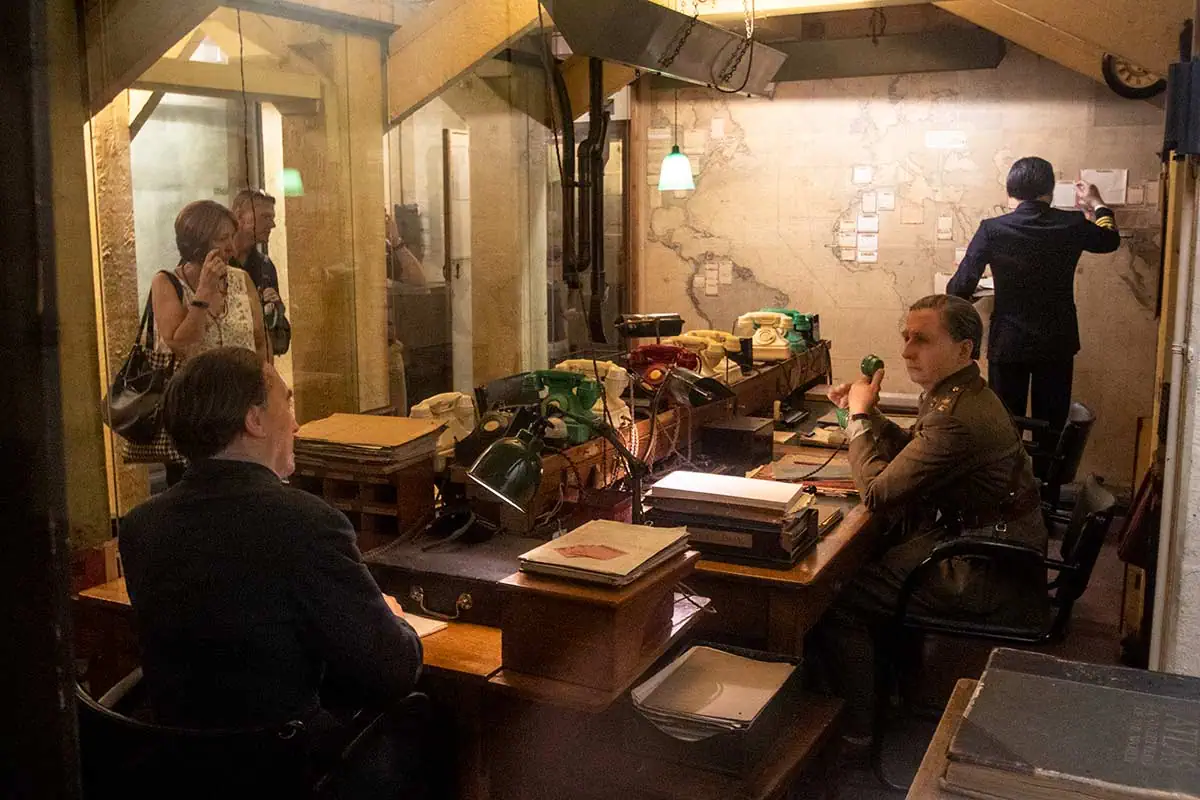
The Map Room Open Every Hour for Six Years
The Map Room ran 24 hours a day, 7 days a week, from 27 August 1939 to 16 August 1945. It never closed. Three mapkeepers and a duty officer per shift tracked every convoy, every troop movement, and every naval engagement across the world. Every morning at 9am they sent the Map Room Bulletin to the King, Churchill, the Chiefs of Staff, and the War Cabinet. It was the only accurate picture of the war anyone had.
The ship convoy map was so heavily pinned that parts of the paper wore through and had to be patched. Every pin was a ship. Every ship carried food, weapons, oil, and American troops. Everyone was within range of German U-boats. Churchill said the U-boat war kept him awake at night more than anything else. You can see why, standing at that map.
When the IWM catalogued the room in the early 1980s, they found an envelope in a desk drawer. Three sugar lumps. Wing Commander John Heagerty, the last duty officer in this room, had scraped a little from his weekly ration each shift and saved it for his tea. When Japan surrendered, he walked out and forgot it. The sugar sat in that drawer for 40 years. A world war run by real people who just wanted a cup of tea.
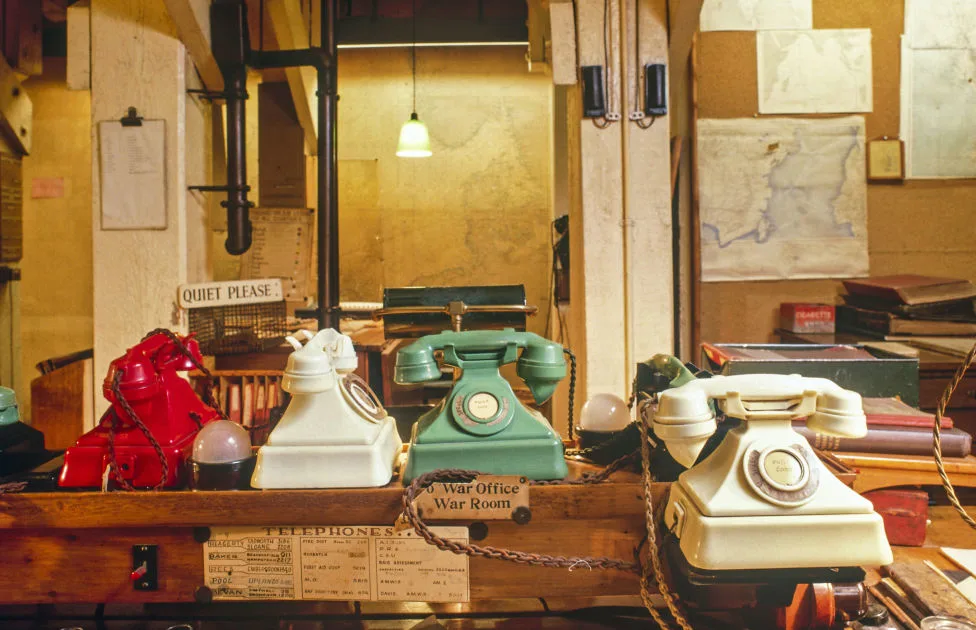
The Transatlantic Telephone Room The “Engaged” Sign That Fooled Everyone
The door has an “Engaged” sign. Staff assumed it was Churchill’s private bathroom. There was no running water on this level. There was never a toilet.
Behind that door was a terminal connected to the sub-basement of Selfridges on Oxford Street, 3 kilometers from King Charles Street. Two basement levels held the racks for SIGSALY, the first digital voice encoding system ever built, developed by Bell Telephone in America. It digitized the human voice, added random noise, transmitted it across the Atlantic, and reconstituted it at the Pentagon. Impossible to intercept.
Churchill could not call Roosevelt spontaneously. He booked a slot. The discs at both ends had to start simultaneously. When the line was ready, he walked in and closed the door. The staff outside assumed he was in the bathroom. Nobody who worked here knew what those conversations contained. Your guide tells you this before you reach the door.
Churchill’s Bedroom: Three Nights and a Roof During the Blitz
Churchill slept here three times. He hated the basement. His flat in the Number 10 Annex directly above, running water, and a proper bathroom suited him far better. Two baths a day. A jug of cold water was never going to work.
His routine was remarkable for a man in his late 60s. In bed working from 8am. Full day of meetings. Back to his nightshirt at 3pm for 90 minutes. Second bath at 5pm. Work until 2am. His staff was broken. He was still going.
On the heaviest bombing nights he did not go underground. He went to the roof of the Treasury on Great George Street and watched London burn through binoculars. His private secretary, Jock Colville, recorded it. Churchill refused every instruction to come down. The bedroom maps are covered by curtains closed for anyone without security clearance. Four BBC broadcasts came from that desk. Clementine used the same desk for her Aid to Russia Fund addresses. The velvet siren suit in the corner was made by Turnbull and Asser on Jermyn Street, 12 minutes from here. He called them “rompers.” Paid thousands each. Wore them anyway.
Churchill Was Not Hiding. The Real Story.
Where was Churchill hiding during the Battle of Britain?
He was not hiding. The IWM Curator, Nigel Steel, addressed this directly: Churchill believed he had a destiny. His destiny was not going to be ended by a German bomb over Whitehall. He stood on rooftops during air raids. He toured the southern coast inspecting defences while bombs fell on Kent. He flew to Washington. He travelled abroad at least 25 times during the war more than any other wartime leader of any nation involved in the conflict.
The Underground scene in the film Darkest Hour Churchill among ordinary Londoners on a tube carriage, asking them whether Britain should fight or seek terms never happened. Screenwriter Anthony McCarten confirmed it himself: “That scene was drawn from deep research, but we have no record that it happened.” Churchill took the Underground once in his life. He became completely lost and had to be rescued.
Your guide tells you where Churchill actually was on the days those scenes are set. And what really happened on those days which is considerably more interesting than what the film invented.
Is a Private Tour Worth It? An Honest Answer
The most common question before booking: is a private guide worth it, or does the audio guide do the same job?
The audio guide is good. A London Destination Expert on TripAdvisor with 33,000 posts said so directly. The IWM version covers everything in eight languages. If you are going alone on a budget, use it.
Here is the difference. The audio guide tells you what is in each room. Your guide tells you what happened in each room.
The “Engaged” sign the audio guide says bathroom. Your guide tells you there was no running water on this floor. No plumbing. No bathroom. Behind that door was a terminal connected to a system in the basement of Selfridges on Oxford Street the first digital voice encoder ever built. Your guide tells you this before you reach the door.
The sugar lumps the audio guide describes the display. Your guide tells you about Wing Commander John Heagerty, who scraped sugar from his weekly ration and saved it for his tea, walked out when Japan surrendered, and left it in that drawer for 40 years. One detail. One real person. That is the difference.
One visitor who did the War Rooms twice audio guide first, private tour second said it plainly: “Just being able to move around without crowds was a massive bonus.” Another called it “one of our favourite tours out of all the tours we’ve done across multiple cities and countries.” The guide’s knowledge was the reason.
Who Is This Tour Best For
This tour is built for WWII history enthusiasts, American and international visitors with a serious interest in Churchill, couples on meaningful trips, and families with teenagers aged 13 and above. One TripAdvisor reviewer brought 16 and 19-year-olds. Both were fascinated. The IWM’s own Secrets Guided Tour is intended for over 16s. With a private guide calibrating to your group, 13 and above works well especially teenagers who have covered WWII in school.
For corporate groups, this is the most powerful leadership setting in London. 116 Cabinet meetings. A man in his late 60s running a global war from a basement he knew was not bombproof, convinced he was going to win. The QEII Centre on Broad Sanctuary SW1P 3EE four minutes from King Charles Street hosts conferences regularly. Groups combine a War Rooms morning with afternoon sessions there.
For families with children under 10, our private London Highlights tour covers more accessible ground across the city.
Is Westminster Safe? What Every Visitor Should Know Before They Arrive
Westminster is the most-visited borough in London and the highest-crime borough in Britain. The Metropolitan Police recorded 41,639 crimes here in just the first six months of 2025. The pickpocketing rate stands at 13,657 thefts per 100,000 people more than 26 times the worst area outside London.
80,000 phones were stolen in London in 2024. A 25% jump from the year before. In central Westminster postcodes, phone theft rose 30 times the national average.
King Charles Street SW1A 2AQ sits in the middle of it. On a private tour your guide leads the route. You are never on Whitehall with a phone above your head. Westminster’s numbers are high because millions of distracted tourists walk through it every year. You will not.
Action Fraud recorded £9.7 million lost to ticket fraud in 2025 a 50% rise from 2023. London accounted for £3 million. Every ticket we book comes directly from the Imperial War Museums. Not an aggregator. Not a tout.
What Real Guests Say
Jeffrey, New York Full Day with Aaron Hunter
“As someone who has taken private tours all over the world, I can say without hesitation that our full-day London tour with Aaron Hunter was truly exceptional. Aaron is, quite simply, a walking encyclopedia of London. After nine full hours, we felt like we had seen and understood London in a way that would have taken weeks on our own.”
Judy, United States Car Tour with Grace and Shorof
“I am a 75-year-old grandma with mobility issues so I was a bit concerned about getting about safely. But it was not a problem. Our guide Grace took us to many of the sites on our list. Our driver Shorof let us off then would pick us up at a designated area. Even with many other tourists around, my walker would be waiting as I exited the car. I felt like a queen.”
Karen, Miami Tour with Monica
“Our guide Monica picked us up at our hotel and we were off. Monica was wonderful and paced the tour incredibly well. We were not rushed at all. We will absolutely use them again every time we are in London.”
Read all 100+ five-star Google reviews at /reviews/.
Got Questions?
We’re happy to help. If you can’t find the info you’re looking for, please don’t hesitate to reach out to us!
Call us at (+44) 7356049464
Book Your Churchill War Rooms Private Tour Available 7 Days
The rooms have not changed since 16 August 1945. The sugar lumps are still in the drawer. The clock still reads 4:58pm. The “Engaged” sign is still on the door.
Only 30,607 Americans who served in World War II were still alive in 2026 less than 0.2% of the 16.4 million who fought. The living connections to these rooms are almost gone. The rooms have not moved.
Now is the time.
PHO Licence 00324. 100+ five-star Google reviews. Groups of 2 to 30. Hotel pickup included. Tickets included. 7 days a week.
Email: bookings@privatelondontours.uk
Available 7 days a week
ABOUT US
Grand Private London Tours is a PHO licensed private tour company covering Central London, Windsor, Stonehenge, Bath, and the Cotswolds. Our guides walk these streets every day. They know which spot on Spur Road gives you an unblocked view of the Changing of the Guard, when the Crown Jewels queue is still short, and which Borough Market stall is worth the wait.
OUR ADDRESS
Areas We Serve
Serving London, England and Beyond
© 2026 Grand Private London Tours