Private British Museum Tour with a London Expert Guide
The British Museum sits on Great Russell Street, Bloomsbury, WC1B 3DG. It holds eight million objects across 990,000 square feet. Most visitors on a British Museum private tour see around forty of them and leave exhausted. This is not a failure of curiosity. It is the nature of the building. Without a guide, the British Museum wins every time.
A private guide changes that entirely. Two and a half hours. A plan. Stories told before you stand in front of each object. You leave knowing what you saw, why it matters, and what it connects to. That is what our guests consistently describe. Not the Rosetta Stone itself. The moment their guide explained it.
100+ Five-Star Google Reviews
Eight Million Objects. Most Visitors See Forty
The British Museum was the first public national museum in the world. It opened in 1759, originally housed in Montague House on the same Bloomsbury site. Today the building covers 990,000 square feet across 60 galleries. The Queen Elizabeth II Great Court, designed by Sir Norman Foster and opened in 2000, is the largest covered public square in Europe. Two acres of it, right in the heart of London WC1B.
Museum fatigue is a documented condition. The term was first used in 1916 by Benjamin Gilman at the Boston Museum of Fine Arts. The British Museum is its textbook example. A 2026 visitor review on trvlogue.com captured it exactly: “I totally got lost. Left exhausted, having seen less than half.”
One Quora contributor with significant London museum experience put it plainly: “If you just walk into the British Museum and wander around, you will get two things out of it: very tired and the impression that humankind has basically spent millennia making pots.”
Another wrote, “The British Museum is excellent, exhausting, and badly served by the idea that you should see it all. You cannot. The building will win.”
A private guide does not try to show you everything. A private guide makes two and a half hours coherent.
If you enjoy combining cultural visits with wider London exploration, our private London walking tours cover the city’s most significant streets and hidden corners with the same level of depth.
What a Guided British Museum Tour Actually Gives You
Every five-star review of every British Museum tour comes back to the same thing. Not the objects. The guide.
“The artifacts were incredible, but without stories or context, I didn’t feel like I had a true appreciation of what I was walking past. A tour would’ve made it come to life.”
“A guide makes all the difference.” Viator reviewer John R, September 2026
“My friends who are NOT museum people usually raved about the tour for the rest of their trip.” The Museum Guide reviewer, March 2026
Here is what a private guide does differently from walking in alone.
Before you stand in front of the Rosetta Stone, your guide has already told you the story of Napoleon’s soldiers finding it used to prop up a wall at Rashid (Rosetta), Egypt, in 1799. You know what the three scripts are. You know why Champollion’s 1822 breakthrough unlocked 3,000 years of Egyptian history. And you know the hidden fact that most visitors never discover: the British added an English inscription to the stone in the early 19th century. There are actually four languages on the Rosetta Stone, not three.
That is the difference. You are not reading a label. You are understanding an object.
Our private London highlights tour pairs well with this for guests who want a full day across both the museum and the city.
London’s Most Trusted Private Tour Company
PHO License 00324. Licensed, vetted, and government-registered. Not a single competitor in this space displays their PHO license publicly. We do.
Over 100 five-star Google reviews. Named guides. Hotel pickup is available for your British Museum visit. The only operator in London currently offering this for a museum tour. WhatsApp is available 24/7 at +44 7356 049464. Email at bookings@privatelondontours.uk.
Jeffrey from New York took a full-day private tour with Aaron Hunter and described it this way: “As someone who has taken private tours all over the world, Aaron is, quite simply, a walking encyclopedia of London. After nine full hours, we felt like we had seen and understood London in a way that would have taken weeks on our own.”
Karen from Miami toured with Monica: “Our guide Monica picked us up at our hotel, and we were off. Monica was wonderful and paced the tour incredibly well. We were not rushed at all. We will absolutely use them again every time we are in London.”
Judy from the United States, who has mobility issues, toured with Grace and Shorof: “I am a 75-year-old grandma with mobility issues. It was not a problem. Our guide Grace took us to many of the sites on our list. I felt like a queen.”
Read all 100+ five-star reviews from guests across the United States, Europe, and beyond.
What Your Private British Museum Tour Covers
Every tour is shaped around your group. These are the highlights your guide brings to life and the stories the vast majority of visitors walk straight past.
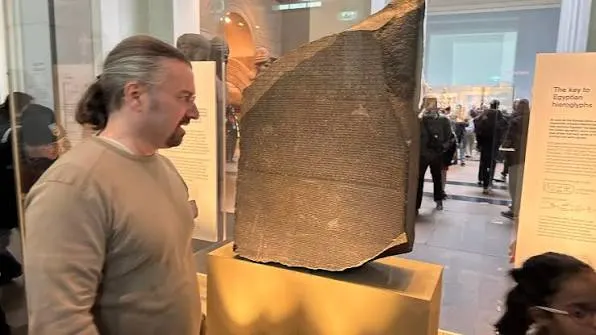
The Rosetta Stone Room 4
It sits in the Egyptian Sculpture Gallery on the ground floor. On most days it is surrounded by visitors, all photographing a broken slab of dark granodiorite. Most spend under two minutes in front of it.
Your guide spends twenty minutes.
The stone dates to 196 BC. Napoleon’s soldiers found it at Rashid (known to the French as Rosetta) in 1799, being used to reinforce a fort wall. Three scripts, ancient Greek, Demotic, and hieroglyphic, all carrying the same decree from the priests of Memphis supporting the boy king Ptolemy V.
The French found it. The British took it under the Treaty of Alexandria. Thomas Young had early breakthroughs. Jean-François Champollion made the decisive discovery in 1822: hieroglyphs are both pictorial and phonetic. They name sounds, not just objects.
The fact your guide shares that almost nobody knows: the British Museum added an English inscription to the stone in the early 19th century. There are four languages on the Rosetta Stone. Not three.
In the Enlightenment Gallery, there is a full-size replica you can touch. Your guide takes you there first, so you understand the object before you face the crowd around the original.
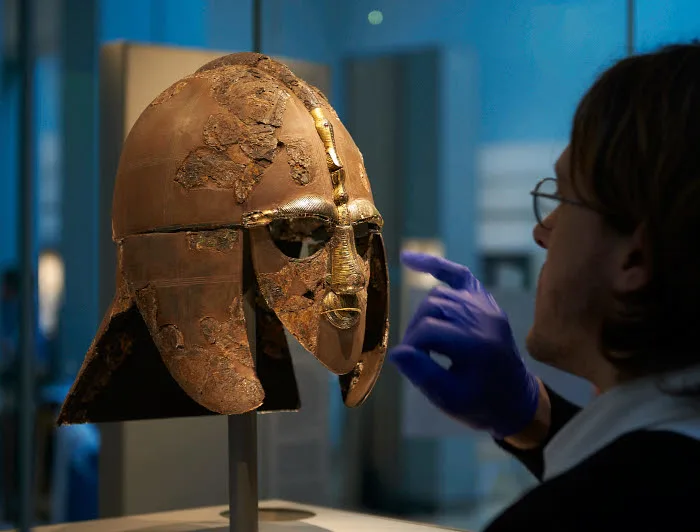
The Sutton Hoo Helmet Room 41
In 1939, an amateur archaeologist named Basil Brown began excavating burial mounds on Edith Pretty’s estate in Sutton Hoo, Suffolk. He found the rivets of a 27-meter ship buried in the earth. Inside: the most intact early medieval grave in Europe.
The helmet was found shattered into hundreds of fragments. Archaeologists reconstructed it. What they discovered when they examined the eyebrows closely has not left me since I first heard it explained properly.
Only one of the eyebrows is backed with gold foil. The other is not.
Stand in front of this helmet by the firelight, which is how it was meant to be seen, and only one eye catches the flame. In that flickering moment, you are in the presence of Woden, the one-eyed god of the Anglo-Saxons.
Nobody was ever found. The acidic Suffolk soil dissolved everything organic. We believe this is the burial of King Raedwald of East Anglia, but we cannot be certain. The gold belt buckle pulled from that earth in 1939 is as dazzling today as the day it was buried in 600 CE. Gold does not tarnish.
If you want to understand Anglo-Saxon Britain, this object does it in one room.
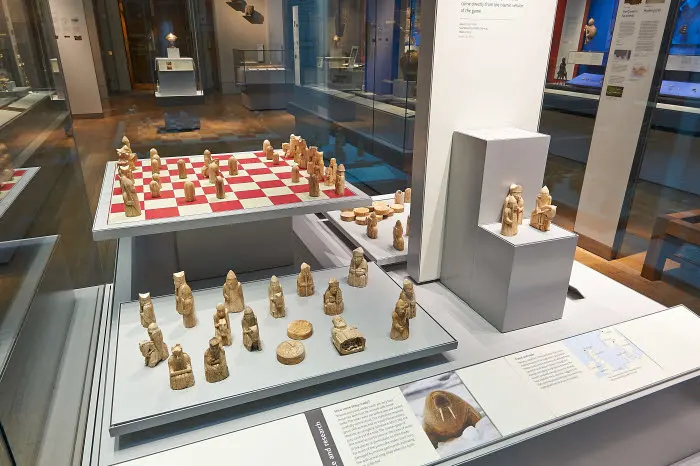
The Lewis Chessmen Room 40
Discovered in 1831 in a church on the Isle of Lewis, Outer Hebrides. They date from the 12th century and are carved from walrus ivory and whale teeth. Ninety-three pieces were found in total. Eighty-two are here. Eleven are at the National Museum of Scotland in Edinburgh.
In July 2019, a single warder, the equivalent of a rook, was discovered in an old antiques collection and sold at auction for £735,000. Multiply that by ninety-three pieces.
Children who have seen Harry Potter and the Philosopher’s Stone will recognize these immediately. The chess pieces used in the film’s giant chess match were modeled directly on the Lewis Chessmen. Your guide uses this as an entry point for younger visitors before going deeper into what the Berserkers’ knights biting the edges of their shields tell us about Viking warrior culture and the Icelandic word that gave English the word “berserk.”
Families consistently tell us this room is where their children become genuinely interested in history for the first time.
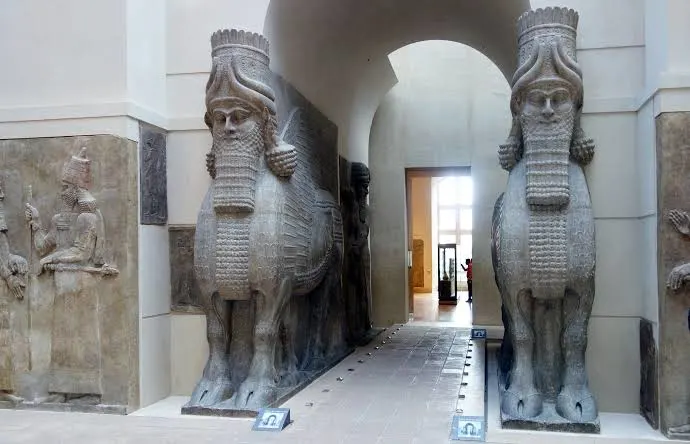
The Assyrian Lamassu Near Room 10
Each of these winged human-headed bulls weighs 16,000 kilograms. When they arrived in London in the 19th century from the gates of the ancient city of Khorsabad in northern Iraq, they had to be chopped into four pieces each to make the journey.
Eight centuries before Christ, these stood at the entrance to an Assyrian city and watched over everyone who passed through. Five legs: two from the front, four from the side. At all times, they appear to be walking toward you.
A few years ago, conservators cleaning the surface discovered something scratched into the stone beneath centuries of grime. It was the Royal Game of Ur, one of the oldest board games in the world. Guards played it on night duty. Two thousand seven hundred years ago.
Your guide points to the scratched board and says, “Human nature has not changed in two thousand seven hundred years.”
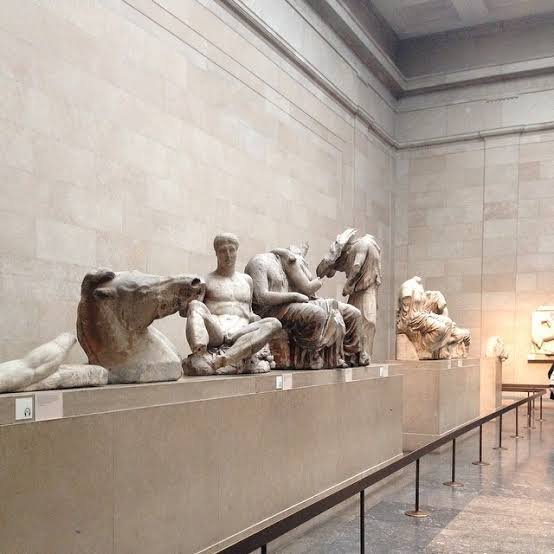
The Elgin Marbles Room 18
Carved between 447 and 432 BC under the direction of the sculptor Pheidias, these are the most contested objects in any museum anywhere in the world. They were part of the Parthenon, the temple of Athena on the Acropolis in Athens, before Lord Elgin removed them in the early 19th century.
Your guide gives you the context without the argument. You see the Frieze, the Metopes, and the pediment sculptures. You understand what they depicted, what the Parthenon was, and why this room feels so charged. You leave to be able to form your own view.
The Bayeux Tapestry Is Here Until July 2027 Your Guide Will Make It Count
No competitor is covering this. None of them.
The Bayeux Tapestry arrived at the British Museum on 10 September 2026. It closes on 11 July 2027. It is the first time it has ever left France.
The first day of ticket sales generated £2.4 million. Between 40,000 and 55,000 people joined the online queue. Some waited eight hours. Tickets for the entirety of 2026 sold out within days. Museum director Nicholas Cullinan appeared on the BBC to apologise: “Really sorry.”
A photography ban was introduced in October 2026, slowing visitor flow. Timed slots are forty minutes. Visitors are being asked to keep moving.
The tapestry is seventy metres long. It depicts the Norman Conquest of 1066 in visual narrative form, with no text explanation for modern visitors. Standing in front of it without context means moving through seventy metres of medieval embroidery you cannot fully read.
Your guide pre-briefs you before you enter. You hear the story of William, Harold, Hastings, and 1066 while you are still standing in the Great Court. By the time you walk in, you know who every figure is, what every scene means, and where to look in your forty-minute window.
That forty minutes becomes forty minutes of understanding rather than forty minutes of beautiful confusion.
Book early. We can advise on securing Bayeux Tapestry timed tickets when you book your tour. See how booking works.
Who This Tour Is Perfect For
Families visiting London with children
The Lewis Chessmen are the Harry Potter chess set. The Egyptian mummies are every child’s favourite gallery. One family reviewer put it this way: “Before this, we have never been able to keep our kids interested at a museum for more than one hour max.” A private guide knows how to keep children engaged without losing the adults.
American visitors
Six and a half million people visited the British Museum in 2024 to 2025. Three point eight million were from overseas Americans are the largest single group. The Rosetta Stone. The Elgin Marbles. Egyptian mummies. These are objects American visitors have read about for years. A private guide makes them personal.
History enthusiasts
The Vindolanda tablets in the Roman Britain gallery were voted the most important objects in the British Museum by the British public in 2017. They are personal letters written by Roman soldiers posted near Hadrian’s Wall, around 100 CE. One of them is a birthday party invitation from a woman called Claudia Severa to her friend one of the earliest examples of Latin writing by a woman ever found. Most visitors walk past them.
Couples and milestone visitors
The Queen Elizabeth II Great Court alone Norman Foster’s glass and steel roof covering two acres of central London is one of the most breathtaking interior spaces in England. A private tour means your pace, your questions, your experience. Karen from Miami described it as being paced “incredibly well. We were not rushed at all.”
Guests with mobility requirements
Judy from the United States, a 75-year-old with mobility issues, toured with our guide Grace: “It was not a problem. I felt like a queen.” We accommodate wheelchairs, pushchairs, and any pace. Please mention your requirements when booking.
For guests who want to extend their day, our Westminster Abbey private tour is a fifteen-minute walk south through Bloomsbury and Covent Garden, connecting two of London’s most significant sites. Our Churchill War Rooms private tour is a short ride away in Westminster.
The Best British Museum Tour in London What We Offer That Nobody Else Does
We collect you from your hotel and take you to the museum. Zero competitors offer this for a British Museum tour. You do not navigate the tube on your first London morning. You arrive with your guide.
Legally registered, government-vetted, publicly accountable. Check the licence. Not a single competitor in this space displays theirs.
Message us at +44 7356 049464 at any hour. Travel plans change. We are there when they do.
The British Museum has mandatory security screening for all visitors. No tour company on earth can skip it. We will never tell you otherwise. What we can tell you is this: there is a second entrance on Montague Place, at the back of the museum. On a busy summer weekend, there can be an hour-long queue at the main Great Russell Street entrance. The Montague Place entrance regularly has a five-minute wait. Your guide knows exactly where to go.
Aaron Hunter. Monica. Grace. You know who is meeting you before you arrive. Our guides are not interchangeable.
Got Questions?
We’re happy to help. If you can’t find the info you’re looking for, please don’t hesitate to reach out to us!
Call us at (+44) 7356049464
Book Your British Museum Private Tour Today
The British Museum stands on Great Russell Street, Bloomsbury, London WC1B 3DG. Russell Square tube station is a three-minute walk. Tottenham Court Road and Holborn are both within ten minutes on foot. We can collect you from your hotel anywhere in central London and bring you to the door.
A private British Museum tour is not the same as walking in alone. It is a fundamentally different experience of the same building. The objects do not change. What changes is whether you understand what you are standing in front of.
Email: bookings@privatelondontours.uk
PHO Licensed: PHO 00324
Available 7 days a week
ABOUT US
Grand Private London Tours is a PHO-licensed private tour company covering Central London, Windsor, Stonehenge, Bath, and the Cotswolds. Our guides walk these streets every day. They know which spot on Spur Road gives you an unblocked view of the Changing of the Guard when the Crown Jewels queue is still short and which Borough Market stall is worth the wait.
OUR ADDRESS
Areas We Serve
Serving London, England, and Beyond
© 2026 Grand Private London Tours